Stoicism Is Not About Suppressing Emotion — Here’s What It Actually Does
Open any feed and you’ll meet the cartoon Stoic: jaw set, feeling nothing, “detaching” from everything that hurts. It’s the most common thing said about Stoicism — and it’s wrong. The Stoics weren’t trying to feel nothing. They had a precise theory of what emotions are and what to do with them, and it’s far more interesting than “don’t cry.”
“Manage, don’t suppress” — and where most explanations stop
To be fair, the correction is everywhere now: Stoicism is about managing emotions, not suppressing them. True — but most articles stop at the slogan. They rarely explain the part that makes it true: the Stoic account of what an emotion actually is. That’s where the usable idea lives.
The Stoics thought emotions were judgements
For the Stoics — whose psychology was systematised by Chrysippus — a passion (pathos) isn’t a mysterious force that happens to you. It’s a value-judgement. When you’re consumed by anger or dread, you have, in effect, judged some external thing to be far more good or bad than it really is. Change the judgement and the emotion changes with it. That’s why this is a philosophy you can practise, not just admire.
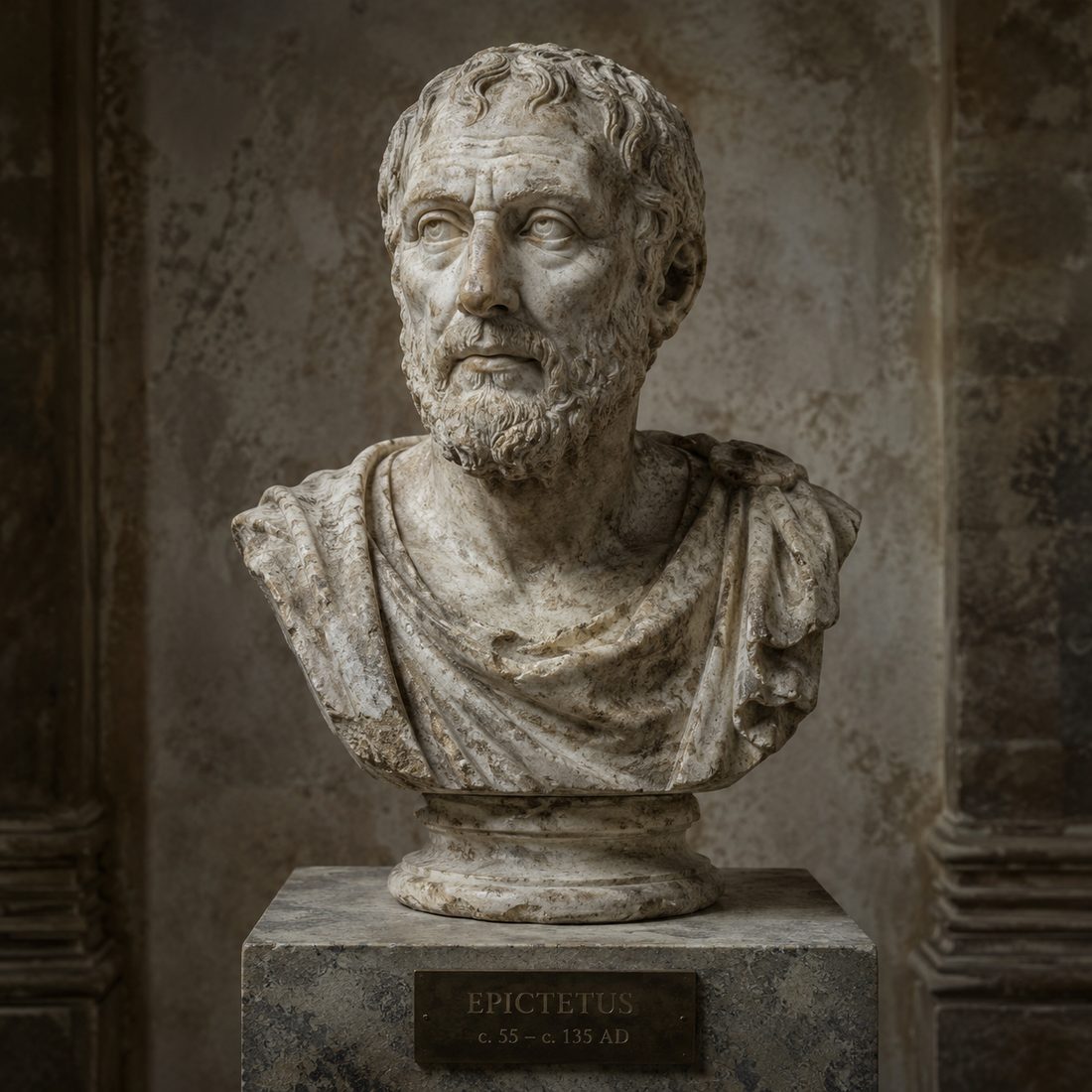 Epictetus on a museum pedestal.” class=”wp-image-1542″ style=”border-radius:6px”/>
Apatheia is not apathy
The Stoic goal is apatheia — but the word is a false friend. It does not mean apathy, that numb indifference we associate with the word today. It means freedom from the destructive passions. In their place the Stoics expected the wise person to feel the eupatheiai, the “good feelings”: joy (chara), caution (eulabeia), and rational wish (boulesis). These aren’t diminished emotions — they’re clear-eyed ones. (See the Internet Encyclopedia of Philosophy on Stoic psychology.)
Do not disdain to … groan with him. Take heed, however, not to groan inwardly too.
Epictetus, Enchiridion 16 (trans. Elizabeth Carter)
Read that again: groan with the grieving — outwardly, sincerely. Just don’t let the grief conquer the judgement underneath. That is management, not suppression.
Even the emperor wept
The most famous Stoic we have, Marcus Aurelius, was no stone. According to the Historia Augusta — a late and not always reliable source, so treat this as tradition rather than hard fact — when the young Marcus wept at the death of his tutor and courtiers tried to restrain him, the emperor Antoninus Pius intervened:
Let him be only a man for once; for neither philosophy nor empire takes away natural feeling.
Antoninus Pius, reported in the Historia Augusta (Life of Antoninus Pius)
Whether or not it happened exactly so, the line states the doctrine precisely. Philosophy was never meant to remove feeling — only to keep it from running the show.
Why the difference matters
Two reasons. First, the suppression myth isn’t just inaccurate, it’s harmful: bottling emotion tends to make it stronger, not weaker. Second, the cartoon version curdles into something the Stoics wouldn’t recognise — “stoic” as a mask for hardness and contempt. Real Stoicism puts justice and kindness at the centre; Marcus thought gentleness was the more manly thing. (More in our guide to Marcus Aurelius and to Stoicism itself.)
How to practise it
- Name the judgement, not just the feeling. Behind the anger is a verdict — “this should not be happening to me.” Examine the verdict.
- Pause between impression and reaction. The feeling arrives uninvited; assent is yours to give or withhold.
- Feel it, don’t feed it. Let grief or fear be real — just stop rehearsing and amplifying it.
- Aim for the “good feelings.” Gratitude, steady joy, rational caution. Those are the targets, not numbness.
Stoicism never asked you to stop feeling. It asked you to stop being run by feelings you never examined. That’s harder than going numb — and far more worth doing.
Sources
- Stoicism — Internet Encyclopedia of Philosophy
- Stoic passions & the eupatheiai — Wikipedia
- Apatheia — Wikipedia · Apathy — Britannica
- Epictetus — IEP · Marcus Aurelius, Meditations — Project Gutenberg
- Historia Augusta — Wikipedia
Read next: What Stoicism actually is · Marcus Aurelius · Memento Mori