
Amor Fati: What Nietzsche Borrowed From the Stoics — and What He Didn’t
“Amor fati” — love of fate — is having a moment: on wrists, on mugs, on a thousand motivational posts, almost always filed under ancient Stoic wisdom. That’s not quite right. The phrase is Nietzsche’s, the idea is older than him, and the gap between his version and the Stoics’ is the interesting part.
It’s Nietzsche’s phrase — not the Stoics’
Despite how often it’s called “an ancient Stoic phrase,” you won’t find amor fati in Marcus Aurelius, Seneca, or Epictetus. The Latin formula is Friedrich Nietzsche’s. He introduces it in The Gay Science (§276) and, in Ecce Homo, calls it his “formula for greatness.” (For the philosophy, see the Stanford Encyclopedia of Philosophy.)
I want to learn more and more to see what is necessary in things as beautiful … Amor fati: let that be my love from now on.
Friedrich Nietzsche, The Gay Science §276
What he borrowed: the Stoic root
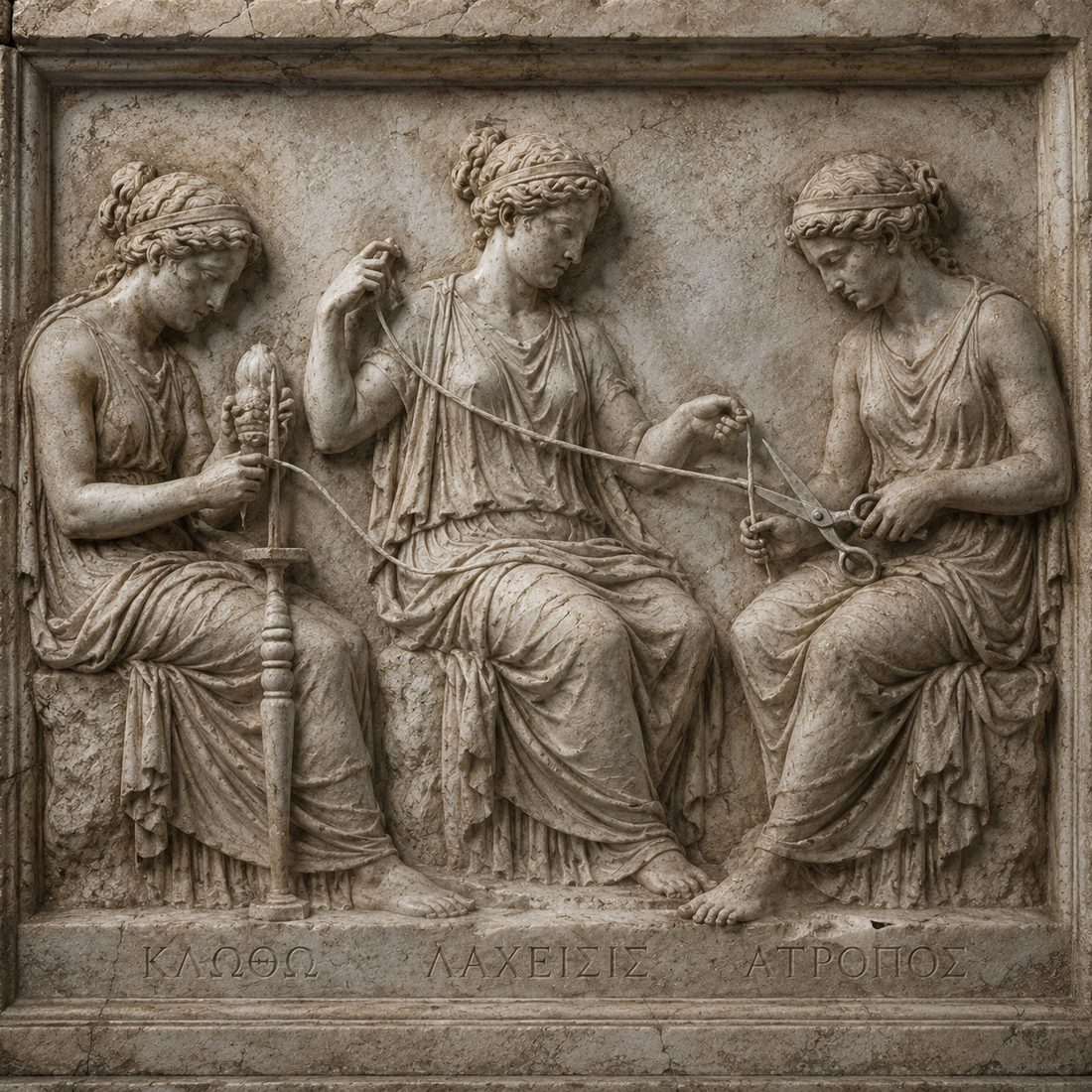
The idea underneath — willing what happens instead of fighting it — is deeply Stoic. The Stoics held that the cosmos is governed by fate, and that the good life means living “in agreement with nature.” Their founder-poet Cleanthes put it as a prayer — one Epictetus loved enough to quote at the very end of his handbook:
Lead me, O Zeus, and thou, O Destiny, / wherever your decrees have assigned me. / I follow readily; but if I choose not, / wretched though I am, I must follow still.
Cleanthes, quoted in Epictetus, Enchiridion 53
Follow willingly, or be dragged — but follow either way. Seneca compressed the same thought: fate leads the willing and drags the unwilling. That posture — saying yes to what you cannot change — is what Nietzsche inherited.
What he changed: affirmation, not alignment
Here is where they part. The Stoics loved their fate because they believed the universe was rational and providential — an ordered cosmos going somewhere good. Nietzsche kept the love and threw out the providence. For him there is no cosmic plan to be reconciled to; existence has no built-in purpose — and the task is to love it anyway, so completely that you would will every moment to return forever (his idea of eternal recurrence). He even mocked the Stoic command to “live according to nature” (Beyond Good and Evil). Stoic amor fati is acceptance of a rational order; Nietzsche’s is affirmation without a net.
How to actually practise it
Stripped of the metaphysics, both versions point to the same discipline:
- Aim past acceptance. Don’t just tolerate what happened — look for what it makes possible. “Bear the necessary” is Stoic; “love it” is the harder, Nietzschean upgrade.
- Use the recurrence test. Would you be willing to live this exact moment again, endlessly? A brutal, clarifying question about how you’re spending your life.
- Don’t confuse it with toxic positivity. Amor fati isn’t pretending bad things are good; it’s refusing to be made smaller by them.
- Apply it to what’s done, not what’s open. For the past and the unchangeable: love it. For what you can still affect: act. It’s no excuse for passivity.
Loving your fate isn’t resignation, and it isn’t a slogan for a mug. It’s the decision to stop wishing your life had been different — and to use the one you got.
Sources
- Amor fati — Wikipedia · The Gay Science — Wikipedia
- Friedrich Nietzsche — Stanford Encyclopedia of Philosophy
- Cleanthes — Wikipedia · Epictetus — IEP
- Eternal recurrence — Wikipedia
Read next: What Stoicism actually is · Seneca · Memento Mori