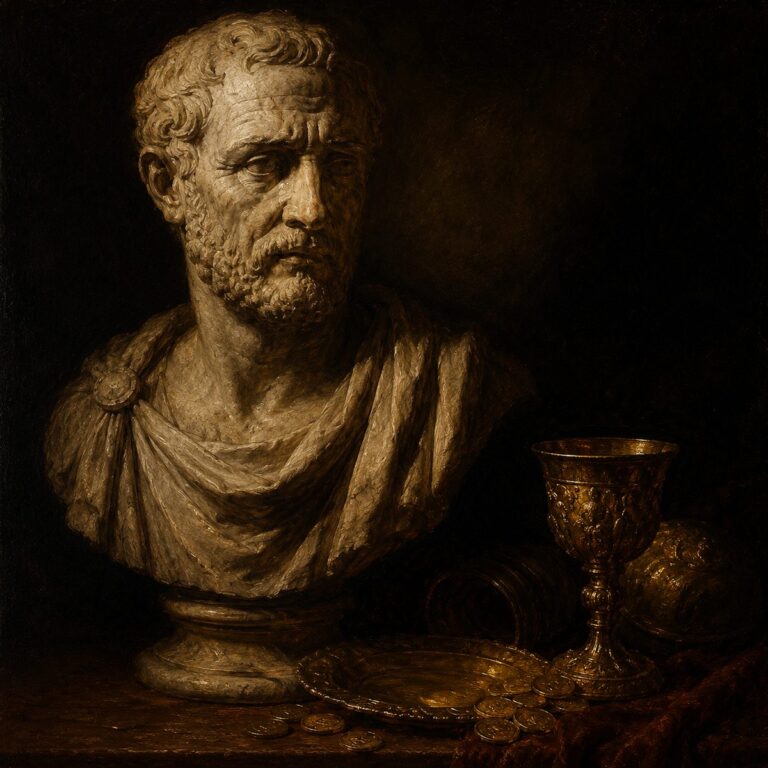

A Stoic Morning Routine: How to Start the Day Like Marcus Aurelius
How you start the morning sets the tone for the day and most of us start it the same way: reaching for the phone before we’re even upright, handing our attention to other people’s agendas before we’ve set our own. The Stoics started differently. Marcus Aurelius, who had an empire waiting for him every morning, used his first waking minutes to prepare his mind. Here is a Stoic morning routine in four steps, drawn from what Marcus and Epictetus actually did.
None of it needs an app, a cold plunge or a 5am alarm. It needs a few quiet minutes before the day grabs you.
Step 1 — Get up for the right reason
The first battle is simply getting out of bed, and Marcus fought it too. His remedy was to remind himself what he was getting up for:
In the morning when thou risest unwillingly, let this thought be present — I am rising to the work of a human being.
Marcus Aurelius, Meditations 5.1 (trans. George Long)
Not “I’m rising to grind,” not “to win” to do the work of a human being: to be useful, to act with character. Reframing the alarm from burden to purpose is a small move that quietly changes the whole morning.
Step 2 — Rehearse the day before it happens
Before the day began, Marcus previewed it specifically the friction:
Begin the morning by saying to thyself, I shall meet with the busybody, the ungrateful, arrogant, deceitful, envious, unsocial.
Marcus Aurelius, Meditations 2.1 (trans. George Long)
This is premeditatio malorum applied to the day ahead. Naming, in advance, the difficult people and problems you’re likely to meet means none of them can ambush you and you get to decide, while you’re calm, how you want to respond, rather than improvising in the heat of the moment.
Step 3 — Draw the line of control
Next, set the day’s terms with Epictetus’s basic distinction: some things are up to you, most are not. Take a moment to sort the day’s big items — what you can actually govern (your effort, your responses, your priorities) versus what you can’t (other people, outcomes, the markets, the weather) and resolve to spend your energy on the first column. It’s the most practical idea in Stoicism, and morning is the cheapest time to apply it.
Step 4 — Set one intention worth having
Finish with a single intention not a task, a quality. “Today, patience.” “Today, I won’t be ruled by my inbox.” “Today, presence with my kids.” One line, chosen deliberately, that you can return to when the day pulls you off course. The Stoics didn’t write in the morning to record the day; they wrote to direct it.

Bookend it at night
One optional addition makes the whole thing stick: a brief evening review. The Stoics closed the day by asking what they’d done well, where they’d slipped, and what they’d do differently the same nightly self-examination covered in our piece on Stoic journaling. Morning sets the intention; night checks the result. Together they form a loop that slowly reshapes how you live.
The whole routine, in five minutes
You don’t need an hour. Before the phone:
- One line to get up: “I’m rising to do the work of a human being.”
- One minute to preview. The day’s friction and decide how you’ll meet it.
- One minute to split. What’s in your control from what isn’t.
- One intention. A quality, not a task to carry through the day.
That’s it. The most powerful man in Rome started his days roughly this way, and you can borrow the method for free.
A morning routine doesn’t have to be a productivity ritual. The Stoic version isn’t about doing more before sunrise; it’s about meeting the day as the person you actually want to be decided in advance, while it’s quiet, before the world gets a say.
Related reading
- Stoicism for Burnout: A Field Guide
- Premeditatio Malorum: Negative Visualization
- Marcus Aurelius on Kindness vs. Anger
Sources
- Marcus Aurelius, Meditations 5.1 and 2.1, trans. George Long (public domain) Standard Ebooks.
- Epictetus, Enchiridion 1, trans. Elizabeth Carter (public domain) Internet Classics Archive (MIT).