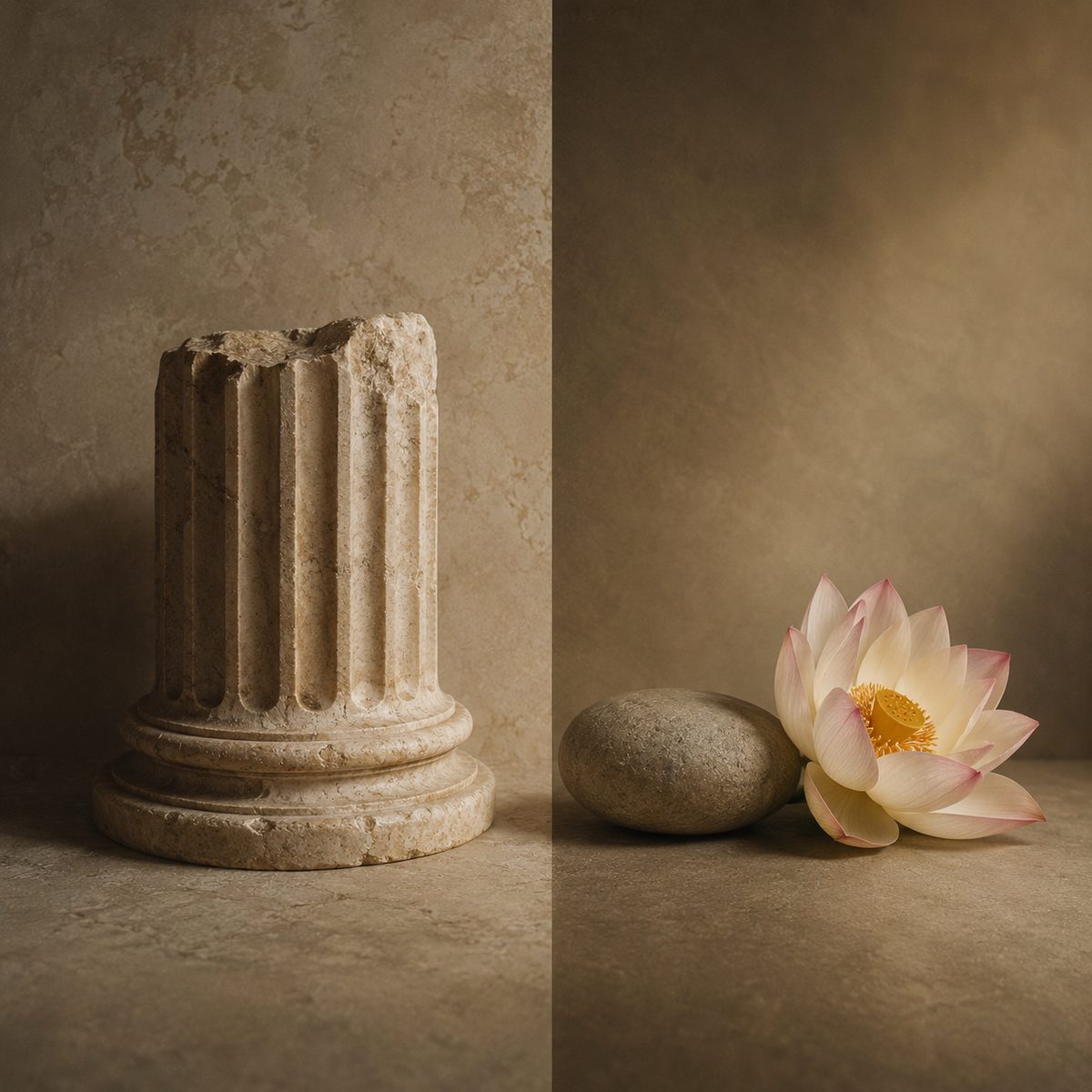
Stoicism vs Buddhism: Two Roads to the Same Calm?
Put a Stoic and a Buddhist in a room and they’ll agree on a surprising amount: that most of our suffering is self-made, that craving and clinging wreck our peace, that the mind can be trained to meet life with equanimity. It’s tempting to conclude they’re the same philosophy in different robes. They’re not and the places they diverge are as interesting as the places they meet.
Here’s a fair comparison: what the two traditions share, where they genuinely part ways, and why it’s lazy to collapse them into one.
Where they agree
The overlap is real and striking, especially given the two arose a continent apart the Buddha in northern India around the 5th century BCE, the Stoics in Athens around the 3rd:
- Suffering is largely self-made. Both locate distress not in events but in the mind’s relationship to them. For Buddhism, dukkha (dissatisfaction) springs from craving; the Stoic version is almost identical in spirit.
- Everything is impermanent. Both insist that all things change and that resisting this is futile. The Stoics rehearsed loss and death; Buddhism makes impermanence (anicca) one of the three marks of existence.
- Equanimity can be trained. Neither treats calm as a temperament you’re simply born with. Both offer daily practices to cultivate it.
- Philosophy is a way of life. For both, the point is not theory but transformation — how you actually live, day to day.
Epictetus could almost be paraphrasing a Buddhist teacher when he writes:
Men are disturbed, not by things, but by the principles and notions which they form concerning things.
Epictetus, Enchiridion 5 (trans. Elizabeth Carter)
Where they part ways
Then the foundations diverge — and not trivially:
- The self. This is the big one. Stoicism assumes a real, rational self a “ruling faculty” you work to perfect. Buddhism teaches anattā: no permanent, unchanging self at all, and clinging to the illusion of one is part of the problem. One tradition perfects the self; the other sees through it.
- The goal. The Stoic aim is eudaimonia flourishing through virtue, lived out in the world. The Buddhist aim, in most traditions, is nirvana liberation from craving and from the cycle of rebirth altogether. Different destinations.
- The cosmos. Stoicism sees a rational, providential universe ordered by logos, and counsels you to align with fate. Buddhism has no creator or providence; reality runs on dependent origination and karma.
- Engagement vs. release. Stoicism is emphatically world-engaging serve, participate, do your duty (Marcus ran an empire; Seneca sat in the senate). Classical Buddhism leans more renunciatory, though the Mahayana bodhisattva ideal turns back toward compassion for all beings.
The Practical Philo’s read
They agree on more than the average Stoic-blog post acknowledges. They also disagree on more than the “they’re basically the same” takes acknowledge. Where they really part ways is metaphysics, and metaphysics matters here, because it shapes what you’re being asked to do.
The Stoic wants you to slot yourself into a rational universe and live well inside it. The Buddhist wants you to see through the self that thinks it has a slot. Those produce different practices and, eventually, different people. If you’re drawn to one but find yourself craving what the other offers, that’s a real signal. Worth following, not smoothing over with “two paths up the same mountain.”
Did they influence each other?
Tempting but the honest answer is probably not directly, and we don’t really know. They emerged centuries and a continent apart. There was some Greek–Indian contact after Alexander, and a few scholars speculate about cross-pollination, but there’s no solid evidence the Stoics learned from Buddhists or the reverse. The likelier story is convergent evolution: two serious traditions working hard on the same human problem suffering and arriving at overlapping answers independently. That convergence is arguably more impressive than influence would be.

So which should you read?
You don’t have to choose, and the differences are exactly why reading both is worth it. If you want a philosophy for acting in the world work, family, duty, adversity Stoicism is built for it, which is why this site leans that way. If you want to investigate the nature of mind and self more deeply, Buddhism goes places Stoicism doesn’t. They are not the same map. But they are charting much of the same terrain, and a traveller is better off carrying both.
Related reading
- Epictetus: The Slave Who Taught Emperors
- Stoicism Is Not About Suppressing Emotion
- Premeditatio Malorum: Negative Visualization
- Stoicism vs Epicureanism
Sources
- “Stoicism” Internet Encyclopedia of Philosophy.
- Buddhist concepts “Anatta” and “Anicca” (Britannica); “Duḥkha” (Wikipedia).
- Epictetus, Enchiridion 5, trans. Elizabeth Carter (public domain) Internet Classics Archive (MIT).